


From The Hollywood Cultural Myths Tarot Grimoire.
There is a kind of power the industry cannot manufacture, and so it does the next best thing: it finds the girl who already has it and calls her a discovery. It takes credit for what it did not make. It wraps feral competence in a press tour and calls the whole operation a star being born. The girl who arrived already armed — already running, already faster than anyone who tried to catch her — becomes, in the industry's telling, a gift it gave the world. These two cards refuse that story. They read it backward. They ask you to look at what she carried in before anyone thought to price it, and what happened after the pricing began.
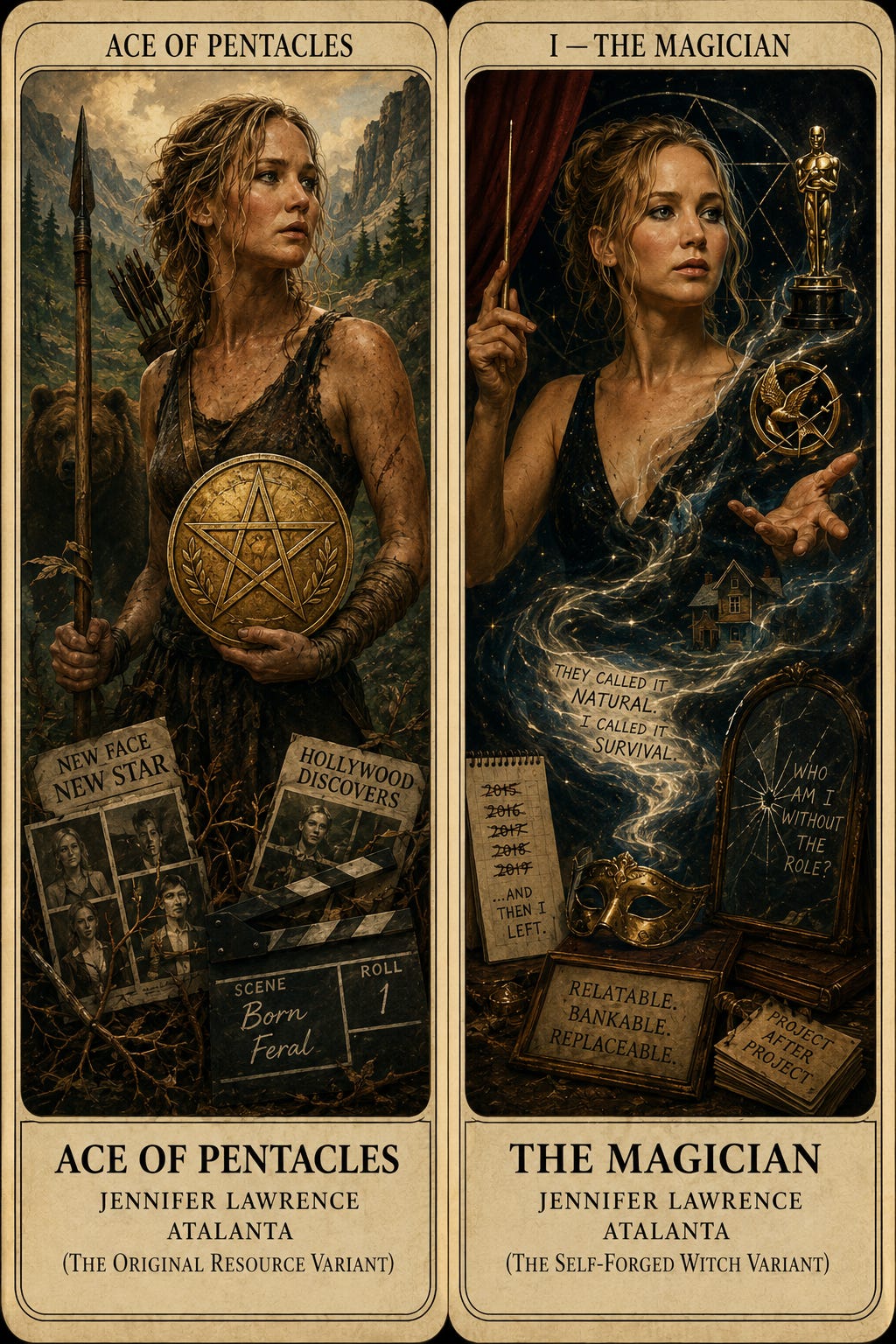
The Ace of Pentacles is not the card of inheritance. It is the card of the original resource — what you were born holding, what no one handed you, what you would have used regardless of whether the world ever agreed to call it valuable. Jennifer Lawrence is Atalanta: the girl exposed on a mountain and raised by bears, which is to say raised by no one, which is to say raised entirely by the ferocity of her own continued survival. She did not come out of a conservatory. She did not arrive through the correct channels. She arrived through a body that already knew how to move, a voice that already knew how to break, and an instinct so precise it read on camera as something audiences could only call *real* — because they had no framework for what she actually was, which was self-forged.
This is what the Ace means when it is upright and blazing: raw talent as self-made weaponry. The first resource. The original stake. Not comfort, not safety, not the soft promise of a floor beneath you — this pentacle is the thing you wield before you know you're in a fight. In Lawrence's case, that meant a physicality that shamed every choreographed action heroine before her, a comedic timing that made craft look like accident, and an emotional directness that the industry immediately commodified under the word *relatable* — a word that has always meant *we can sell this* rather than *we see you.*
When this card reverses, what you are holding becomes what they are taking. Burnout is not a personal failure in the reversed Ace. It is the system's invoice arriving after years of extraction. Atalanta does not lose the race because she is slower — she loses because someone throws golden apples in her path, and she was never told that running was supposed to come with traps. The world fed on her resilience and then asked why she looked tired.
The Magician stands one step further down the road. She has already proven what she can do. The question this card carries is darker: *now that they know, what will they do with the knowing?*
The Magician is not the woman who discovers she has power. She is the woman who has demonstrated it so completely that the world decides the demonstration is the point — that her power exists to serve the act, not the actor. Jennifer Lawrence won the Academy Award at twenty-two for a performance of grief and poverty and bodily desperation that was, in every technical and emotional sense, extraordinary. The industry's response was to make her Katniss, make her Joy, make her every scrappy underdog in every film that needed someone audiences would believe could bleed and keep moving. Her magic was survival. Her trick was making it look effortless. And the punishment for that trick, as it always is, was that the world stopped believing she was working.
Here is what The Magician knows, in this deck: the woman who makes something from nothing is never given credit for the making. She is given credit for the *having*. As though the skill arrived fully formed, as though instinct required no discipline, as though doing it yourself — doing it without the institutional pedigree, the studied lineage, the visible labor — means the doing doesn't count. The Magician upright is the woman who weaponizes what she was mocked for. Who turns the outsider formation into the whole of her technique. Who does it herself because no one else ever showed up.
Reversed, The Magician is the cost of performing your own authenticity until you cannot locate it anymore. Imposter syndrome sharpened so fine it becomes paranoia. Talent exploited until the person wielding it cannot tell the difference between the gift and the obligation. Lawrence stepped back. She took years. The industry called it a slump. What she was doing was refusing to keep paying a tax on her own competence — refusing to be endlessly legible, endlessly available, endlessly *relatable* while the golden apples kept coming.
If this spread has landed in your hands, it is not asking you whether you have talent. It already knows the answer. What it is asking is older and more difficult. It is asking what you arrived with that you have been made to apologize for. What you forged in the absence of instruction and then watched someone else take credit for recognizing. It is asking whether you know the difference between the moment the world valued you and the moment you became valuable — because those are not the same moment, and the gap between them is where the exploitation lives.
You are Atalanta. You outran everyone. This is not a compliment the world has been trained to offer you without conditions attached.
Pick up what you arrived with. Know what it cost to carry it here. And understand: the cards are not asking you to be grateful for having been discovered. They are asking you to notice, with both eyes open, that you were never lost.