


Masculine Arcana — XII The Hanged Man (Heath Ledger / Baldur)
Feminine Arcana — XII The Hanged Woman (Kirsten Dunst / Ophelia)
Suspension is not a pause. It is a sentence.
There is a lie told about this card. That suspension is wisdom. That waiting is voluntary. That stillness is chosen enlightenment rather than imposed gravity.
The Hanged archetype appears when movement has been revoked but interpretation has not. When the body is held in place long enough for the myth to begin speaking.
This is not the card of peace. It is the card of containment disguised as revelation.
The Hanged Man — Heath Ledger as Baldur
(The Sacrificed Son)
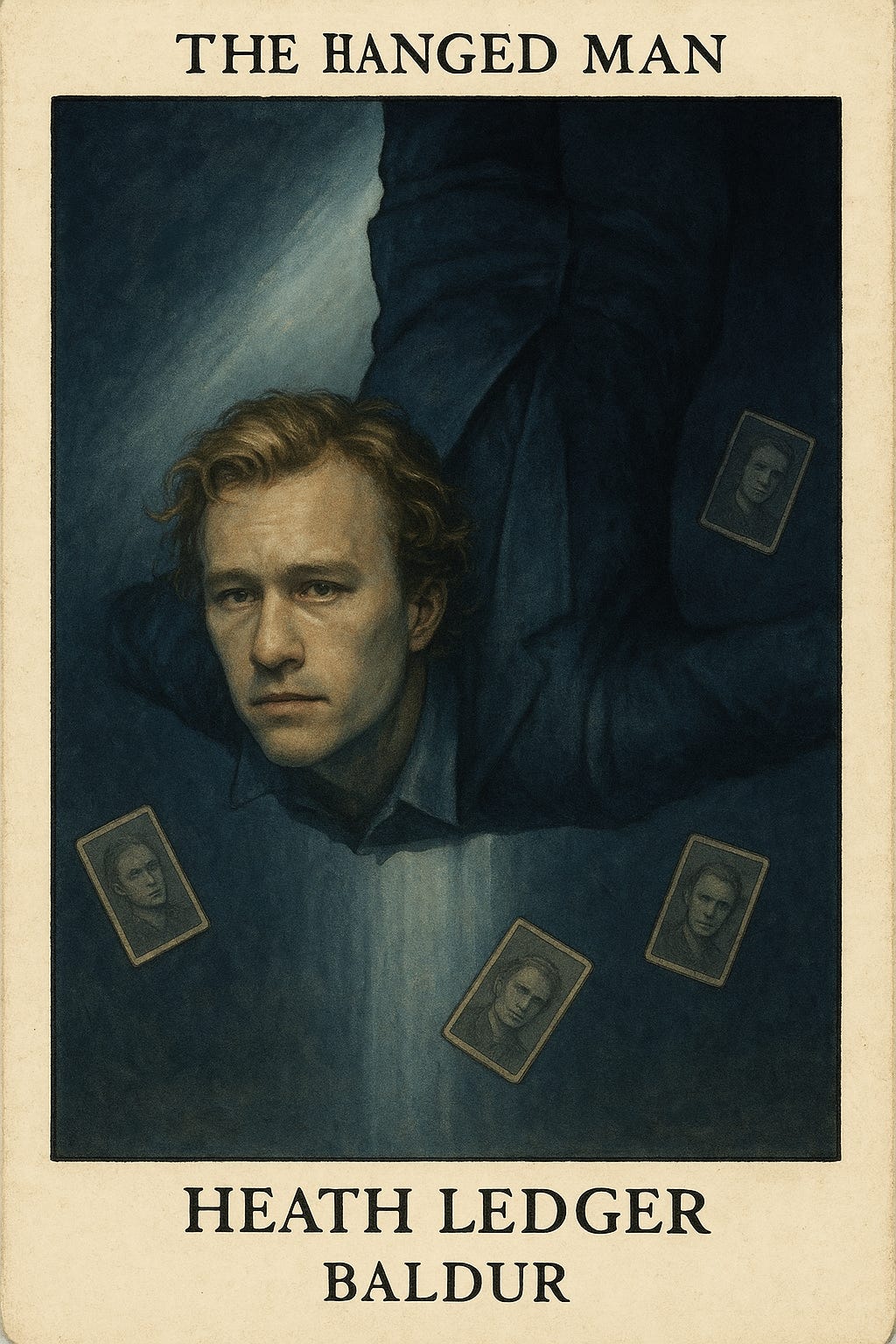
Heath Ledger embodies the Hanged Man because his art required total inversion. He did not perform roles; he surrendered to them. He allowed the work to reorganize his interior life, to inhabit him fully, to cost him something real. His career traces the arc of the sacred sacrifice: beauty offered first, then destabilization, then prophecy spoken through ruin. The Joker was not villainy but exposure—an unveiling of the violence, incoherence, and nihilism at the core of masculine myth. Ledger did not survive the inversion because the system has no infrastructure for men who transfigure instead of dominate. The Hanged Man reveals the cost of seeing too clearly while refusing the armor masculinity demands
The system calls this depth. It is also extraction.
The Hanged Man is not punished for failure. He is immobilized for refusing legibility.
Patriarchy tolerates male suffering only when it can be metabolized into legend. Ledger’s myth indicts that economy. His surrender was read as genius; his collapse was treated as inevitability. The system accepted the sacrifice and moved on.
The Hanged Woman — Kirsten Dunst as Ophelia
(The Suspended Girl)
Where the Hanged Man is inverted publicly, the Hanged Woman is submerged privately.
Kirsten Dunst’s archetype is not martyrdom but arrest. Her characters hover at the moment before rupture—girls and women held in place by expectation, melancholy, beauty, and the demand to feel everything without speaking too much. She is not drowning; she is waiting. The water is not death but density. Memory, depression, longing, and cultural projection thicken around her body until motion itself becomes suspect. The Hanged Woman is the girl paused at the exact second before breaking, romanticized for her stillness and punished for her sadness
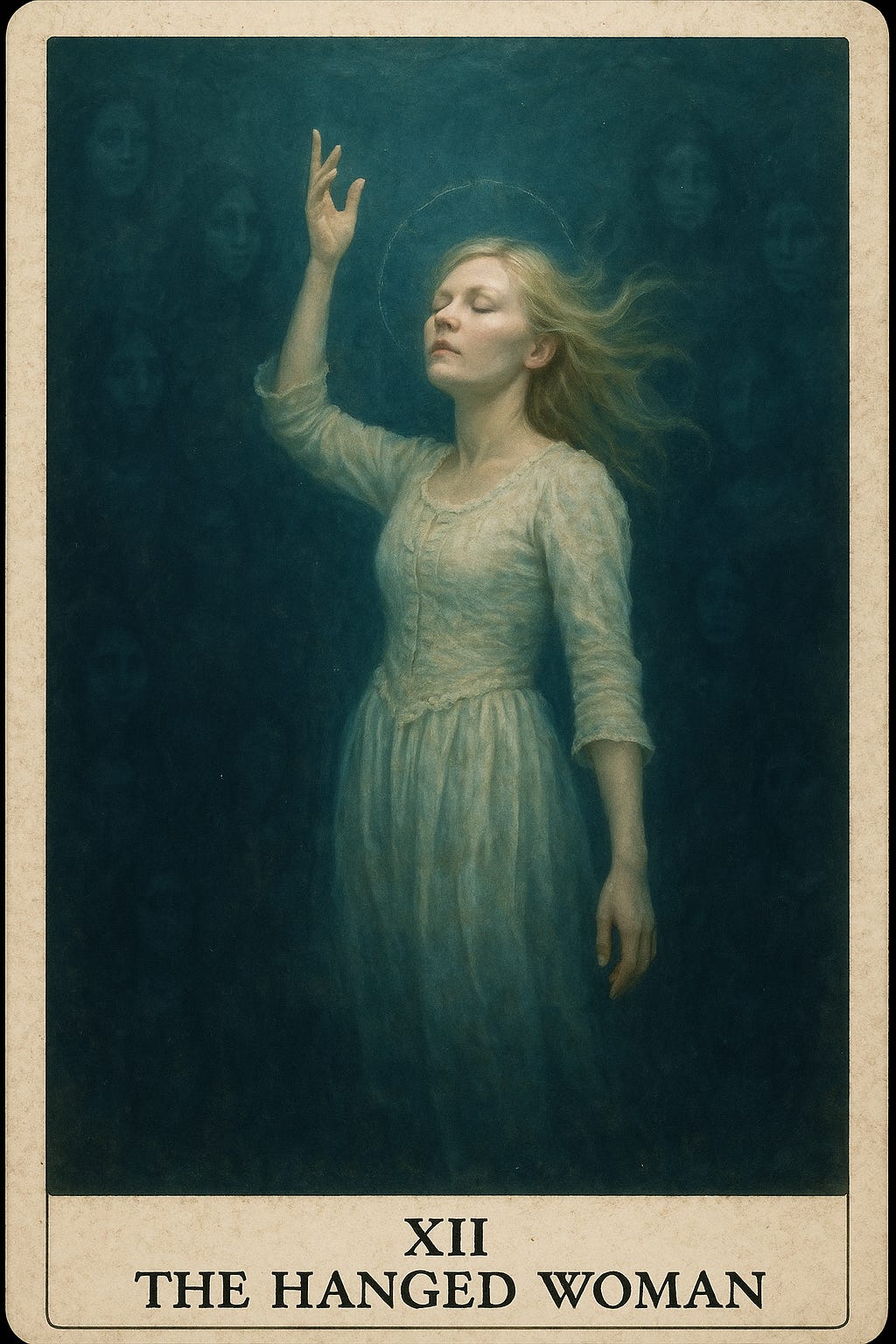
This suspension is not chosen.
Where the Hanged Man is sacrificed for what he reveals, the Hanged Woman is preserved for how she looks while waiting. Her pain becomes scenery. Her sadness becomes myth. The system calls this depth too.
It is also containment.
The Shared Indictment
Together, these cards expose the same mechanism operating along different axes.
Men are allowed to suffer once, spectacularly, if the suffering can be framed as genius.
Women are required to suffer continuously, beautifully, as proof of sensitivity, desirability, or meaning.
Both are immobilized.
Only one is mourned.
This is why the Hanged archetype is not about surrender as virtue. It is about what happens to a body when the story needs it to stay still.
Pull this card when you are being asked to endure something politely. When patience is framed as moral superiority. When stillness is sold as growth while the conditions producing it remain untouched.
The question is not what will happen if you wait. The question is: Who benefits from your suspension?
The Hanged does not predict release. It diagnoses the structure that profits from delay. Sometimes the only way out of a myth is to stop believing stillness is the lesson.
Recognition, not reassurance.